
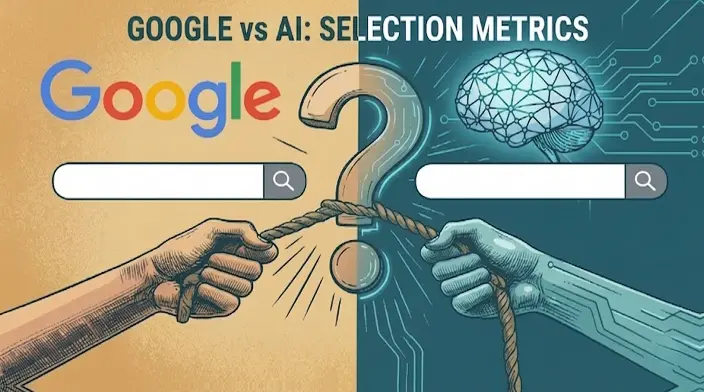

The difference between ranking and being selected and why most established business are optimised for the wrong one.
The Distinction Nobody Is Making
Two systems. Two completely different rules.
Most business owners treat Google and AI search as the same thing with different interfaces. They are not. They operate on fundamentally different logic, reward fundamentally different signals, and produce fundamentally different outcomes for your business.
Understanding the difference is not a technical exercise. It is the single most important strategic shift a professional service firm can make right now. Because one of them is growing fast, and most established business are invisible on it.
How Google Works
Google ranks pages. That is its entire job.
When someone searches on Google, the algorithm returns a ranked list of pages. Ten results. Sometimes more. The user sees them all, chooses what to click, and your website gets a chance to make its own case. A strong headline. A credible first line. A relevant page. You are in the running.
The signals Google uses to rank those pages are well understood: keyword relevance, backlinks, page speed, mobile experience, click-through rates, time on site. A two-decade industry of SEO has been built around optimising for exactly these signals. Most established professional service business have done some version of this work.
Google ranking is real. It matters. It is not going away. But it is solving a different problem from the one your next client may be using to find you.
How AI Search Works
AI selects entities. There is no list. There is one answer.
When someone asks ChatGPT, Perplexity, or Gemini for a recommendation, the process is entirely different. There is no ranked list of options. The AI assembles a response and names specific businesses or professionals it considers credible choices. One answer. Possibly a few names. The decision about who appears has already been made before the user sees anything.
Your website does not get a second chance to correct a weak first impression. The AI has already decided.
The signals AI uses to make that decision have almost no overlap with the signals Google uses to rank pages. AI is not looking at backlinks or keyword density. It is looking for something different entirely.
AI rewards entity clarity. It selects the businesses it can verify, categorise, and describe consistently across multiple sources. Specificity beats volume. Consistency beats prominence. And external evidence beats anything you say about yourself.
A firm can sit on page one of Google and be completely absent from AI recommendations. Both can be true at the same time. Most business have no idea this gap exists.
What AI Actually Looks For
The signals that determine whether AI names your business
When AI evaluates whether to recommend a professional service business, it is essentially running through a set of questions it needs answered with confidence. The businesses that appear consistently in AI recommendations share these traits:
- 1.Specific, verifiable positioning. Not "experienced and trusted" but "commercial litigation, Johannesburg, established 2004, serving mid-to-large corporates." AI categorises what it can classify and skips what it cannot.
- 2.Entity consistency across platforms.The same name, description, and positioning on your website, LinkedIn, Google Business Profile, legal directories, and every other source AI can access. Contradictions read as unreliability.
- 3.Third-party corroboration. AI weights external mentions heavily and discounts self-promotion. A business that only appears on its own platforms carries far less authority than one referenced independently by credible sources.
- 4.Topical depth, not keyword volume. Content that demonstrates genuine expertise on a specific subject outperforms broad content optimised for search terms. AI looks for evidence of authority, not evidence of effort.
- 5.Freshness. Platforms like Perplexity weight content recency so significantly that pages updated in the last three months earn roughly twice as many citations as older material. A website that has not been updated in months signals stagnation.
The Uncomfortable Gap
Most established business are optimised for 2018. AI is reading for 2026.
Here is what makes this urgent. Most professional service business built their digital presence during an era of Google-first thinking. Keywords. Backlinks. A services page. A decent homepage. That work was appropriate for that era.
AI reads that digital presence and finds it incomplete. Not because the work is poor. Because the structure answers the wrong questions. Google needed a page that ranked. AI needs an entity it can verify.
The business being recommended in AI search right now are not necessarily more experienced or more capable than the ones being skipped. They are more legible. Their positioning is clearer, their data is cleaner, and their authority is corroborated by sources beyond their own website. That is a structural advantage. And structural advantages compound.
Every month without addressing this, a competitor closes the gap. And AI does not fluctuate the way Google rankings do. Once AI builds a reliable picture of a business as the credible choice in its category, that picture reinforces itself every time the firm appears consistently.
The Five Questions AI Needs Answered
Before AI recommends your business, it needs to know:
- 1.What exactly does this business do, who do they serve, and where do they operate?
- 2.What evidence exists that they are genuinely expert in this specific area?
- 3.What do third-party sources say about them, independently of their own website?
- 4.Is their positioning consistent and free of contradictions across every platform?
- 5.Can I recommend them confidently without the risk of being wrong?
The Test You Can Run Right Now
Do not take our word for it. Run it yourself.
Open ChatGPT and Perplexity. Search your business name. Read exactly how each platform describes you. Then search your service category and city. See whose names appear and how confidently they are described.
Compare that description to how you would describe your own business. The gap between those two things is the problem. And unlike a Google ranking, which requires algorithm alignment, this gap is fixable through deliberate structural work on the signals AI actually reads.
That is not more content. It is not another website refresh. It is not an SEO package built for 2018. It is a structured approach to making your expertise legible to the systems now doing the recommending.
Google visibility and AI visibility are not the same measurement. Right now, most business are only tracking one of them.
Strategy Call
Find out which one your firm is actually built for.
If you have a strong Google presence but have never tested your AI visibility, the gap is almost certainly wider than you expect. We run an Authority Diagnostic that shows you exactly how AI systems currently see your business, where your Google and AI visibility diverge, and what it takes to close the gap.
We do not work with every business that enquires. We work best with established professional service businesses that have a strong track record and want their digital presence to reflect it. Applications are reviewed within 24 hours. Limited spots available each month.
To apply click the button below, send your business name, website, and a one-line description of your biggest visibility challenge.