
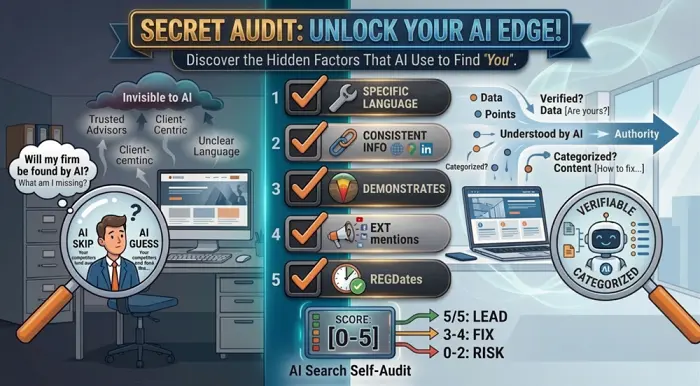

A self-audit for professional service firms who want to know exactly where they stand before AI search leaves them behind.
Most professional service firms fall into the same trap. They built a website that looked credible, ranked reasonably well on Google, and generated enquiries. Then something shifted. Enquiries slowed. Referrals still came, but new clients from search dried up. The website had not changed. The market had.
AI search changed what authority looks like online. What worked in 2019 is actively working against you in 2026. The following five signs tell you whether your website is building authority in the current environment or quietly losing ground to competitors who figured this out first.
Run through each one honestly. At the end, we will tell you what your score means.
Sign 1: Your expertise is described in language only you understand
Read your homepage headline and your about page out loud. Now ask: if an AI system were reading this to extract what kind of firm you are, what would it find?
Phrases like "trusted advisors," "client-centric approach," and "decades of excellence" are invisible to AI. They carry no specific meaning. AI cannot verify them, categorise them, or use them to place you within a field. When AI cannot understand what you do with precision, it either skips you or guesses. Neither outcome serves you.
What authority looks like instead: "Commercial property law. Johannesburg. Established 2001. Serving mid-to-large developers and corporates." Specific. Verifiable. Categorizable.
Self-audit check
Can a stranger read your homepage and state your specialty, location, and ideal client in one sentence? If not, score yourself a 0 on this signal.
Sign 2: Your business information is inconsistent across the web
AI does not rely on your website alone. It cross-references your business against every source where your name appears: Google Business Profile, LinkedIn, legal directories, review platforms, news mentions, industry associations. When it finds inconsistencies, it loses confidence in the information and either presents a vague description or skips you in favour of a competitor whose data is clean.
Common inconsistencies that destroy authority signals: your business name is spelled differently across platforms, your address or phone number varies between listings, your service description on LinkedIn does not match your website, your Google Business Profile has not been updated since 2022.
Every inconsistency is a trust signal lost. AI is not forgiving about this. It reads contradiction as unreliability.
Self-audit check
Search your business name in Google. Open the top five results and compare how your firm is described on each one. If any two descriptions contradict each other, you have an authority problem.
Sign 3: Nothing on your website demonstrates depth
AI platforms are trained on the web. They learn what expertise looks like by reading content that demonstrates it. A website with five service pages and no content record signals a business that has not committed to building authority. It says: we exist, but we are not worth citing.
This does not mean you need hundreds of blog posts. It means you need content that goes beyond describing what you offer and starts demonstrating what you know. A firm that publishes a clear, specific piece on commercial lease disputes in South Africa tells AI exactly what its expertise covers. A firm with only a services page tells AI nothing it can verify.
Volume is not the point. Depth and specificity are.
Self-audit check
Does your website contain any content that specifically answers a question your ideal client would type into an AI? Not a general overview of your services. A specific, useful answer to a real question they have.
Sign 4: No one outside your own platforms is talking about you
AI systems are built to distrust self-promotion. What you say about yourself on your own website carries less weight than what third parties say about you elsewhere. This is not an opinion. It is how the systems are structured. Research consistently shows that third-party mentions, citations, and references are among the strongest predictors of AI visibility.
For professional service firms, this means: are you mentioned in industry publications? Do legal or financial directories reference your practice? Have you been quoted in any media? Do your clients leave reviews on platforms AI can read? If the only sources talking about your firm are your own website and your own social media, your authority signal is weak regardless of how good your content is.
Self-audit check
Search your firm name in Google. On the first page of results, how many sources are not your own? If the answer is fewer than three, your external authority footprint is too small.
Sign 5: Your website was last updated when things were different
Freshness is a measurable signal. Perplexity weights it so heavily that content updated in the last three months earns roughly twice as many citations as older content on the same topic. A website that has not published anything new in six months or more is telling AI: nothing is happening here. This is a static entity. Do not prioritise it.
For established firms, this is the most common issue. The business is active, growing, and doing excellent work. The website reflects none of it. AI reads the silence as stagnation.
Self-audit check
When did you last publish anything new to your website? When did you last update your service pages? If you cannot remember, that is your answer.
What your score tells you
Run through all five checks. Count how many you passed honestly.
5/5
Strong foundation. You are ahead of most firms. The work now is maintaining freshness and expanding your external footprint. You may still have gaps that only a full audit reveals.
3-4
Partial authority. AI can find you but is describing you inconsistently or incompletely. You are being recommended in some contexts and missed in others. This is fixable with targeted work.
0-2
Significant authority gap. AI is either skipping your firm entirely or misrepresenting it. Competitors with weaker track records but stronger digital structures are being recommended instead of you.
Scored 0-2 or not sure where you stand?
We run an Authority Diagnostic that tells you exactly how AI systems currently see your firm, where the gaps are, and what it takes to fix them. It is not a general report. It is specific to your business, your market, and your competitors.
If this article described your Professional Service, a strategy call is the right next step.
We work with a limited number of professional service at a time. A strategy call is not a sales conversation. It is a focused 30 minutes where we look at your current digital authority position, identify the gaps that are costing you the most, and tell you exactly what needs to change.
We do not take every enquiry. We work best with established firms who already have a strong track record and want their digital presence to reflect it.
To apply for a strategy call, send your firm name, website, and a one-line description of your biggest visibility challenge- click the button below.